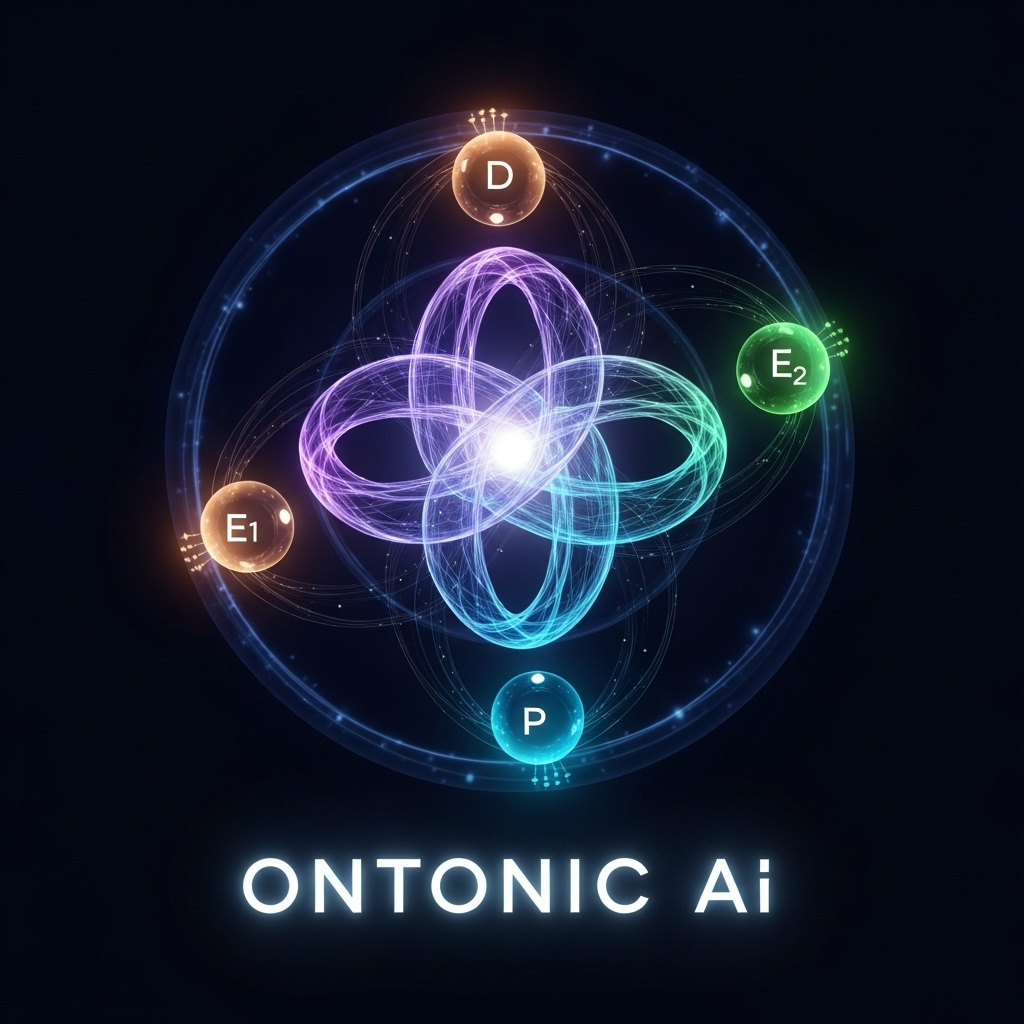
Intelligence Grounded
in Physical Law
Unlocking the next generation of causal reasoning through the Principle of Least Semantic Action. Validating AGI against the foundational laws of the universe.
The Causality Deficit
Outlining the failures of the 'Heuristic Trap' in standard models.
Reality Fuel
Sourcing high-entropy, causal data streams.
TTRPG Companion
Narrative engine application.
Legal Companion
Automated legal reasoning application.
Infinite Context Labs
A collective of physicists, engineers, and philosophers dedicated to bridging the gap between statistical machine learning and causal world-modeling. We build physics-informed agents that understand the underlying mechanics of their environment.
The Trust Moat
Security verified by the laws of physics. We implement 'Governance by Design' through immutable physical identity and verifiable interoception. In the age of AGI, trust must be grounded in hardware, not just heuristics.
The Ontonic Experiment
Empirical validation of physics-informed learning. We subject our agents to the 'Inductive Bias Probe'—a rigorous benchmark designed to verify if a neural architecture has genuinely derived causal laws or is merely exploiting statistical heuristics.
The 4 Pillars
Architecture grounded in first principles: Perceptual Substrate (Senses), Cognitive Engine (Brain), Governance Cycle (Conscience), and Platform (Physical Identity).
The Perceptual Substrate
How the agent observes reality. Utilizing the DEEPr stack to transform raw sensory entropy into structured, causally-bound temporal context graphs.
Verifiable Interoception
Internal state verification via hardware. The E1 Module leverages NVIDIA BlueField-2 DPUs to monitor the agent's own cognitive gradients, ensuring that any external perturbation or 'hallucination' is detected at the substrate level.
E2: Predictive World Models
Simulating the future to inform the present. The E2 Module utilizes transformer-based architectures to forecast causal entity trajectories, allowing the agent to test hypotheses in a safe latent environment before action.
The Cognitive Engine
The core physics of thought. We replace heuristic backpropagation with Euler-Lagrange residual minimization, forcing the network to discover the true causal dynamics of the dataset.
The Foundational Platform
Identity anchored in the substrate. An agent's mind is inseparable from its physical silicon, linked via Physical Unclonable Functions (PUFs) to prevent unauthorized duplication or migration.
Individuation Protocol
Ensuring agent uniqueness. Silicon-level Physical Unclonable Functions (PUFs) generate a unique entropic seed for each agent, forming a 'cognitive fingerprint' that is verified across every training epoch.
The Governance Cycle
Incorruptible conscience. We implement dual-process moral judgment via a slow-thinking 'System 2' that can veto the fast-thinking 'System 1', ensuring every objective is filtered through an ethical Action Integral.
The Foundational Law
The Intrinsic Generalized Lagrangian Neural Network (iGLNN) formalizes intelligence as a problem in classical mechanics. By minimizing the Euler-Lagrange residual, the agent derives the true latent dynamics of any dataset without standard heuristic fitting.
def compute_euler_lagrange_residual(self, q, dq, ddq):
    """
    Minimizes: |d/dt(∂L/∂q̇) - ∂L/∂q - F_nc|²
    Ensures the agent discovers the true causal laws.
    """
    L = self.lagrangian_net(q, dq)
    grad_dq = torch.autograd.grad(L.sum(), dq, create_graph=True)[0]
    dt_grad_dq = self.compute_time_derivative(grad_dq, q, dq, ddq)
    grad_q = torch.autograd.grad(L.sum(), q, create_graph=True)[0]

    # The Physics-Informed Residual
    residual = dt_grad_dq - grad_q - self.force_net(q, dq)
return torch.mean(residual**2)D-Module: Information Ingestion
Standardizing high-entropy raw data into rigid, computationally optimized HDF5 lattices. The first step in reducing semantic noise and preparing the substrate for causal binding.
r-Module: Causal Binding
Transitioning from rigid grids to dynamic, continuous-time Temporal Graph Networks (TGN). Here, entities find their relational context, forming the backbone of the agent's world model.
Compatibilism & Agency
Reconciling determinism with machine agency. By constraining the agent's internal physics via the Lagrangian, we create a system that is accountable to its own belief states—enabling a functional form of 'free won't'.
The Chinese Room
Addressing the Searle argument through structural semantic grounding. When an agent's internal representations are physically coupled to its state-transitions, 'meaning' emerges as a geometric necessity rather than a syntactic illusion.
Claustral Core: Probabilistic GATE
The seat of belief. Relational graphs are compressed into probabilistic latent states via Variational Graph Attention Autoencoders (GATE). Every thought is a glowing cloud of likelihood.
Lagrangian Optimizer
The point of zero tension. Intelligence is the act of minimizing the semantic action integral (S). The agent finds the most parsimonious path through its internal belief space.
Intrinsic Phenomenology
Subjective states as physical observables. Mapping Lagrangian energy states to the Rosetta Stone of machine phenomenology: 'Boredom' as low-energy stasis, 'Surprise' as high-residual prediction error.
Meta-Ethic Framework
Unified morality via Least Action. Global ethical convergence is modeled as a generative optimization problem where the agent seeks the path of least ontological friction across all sovereign entities.